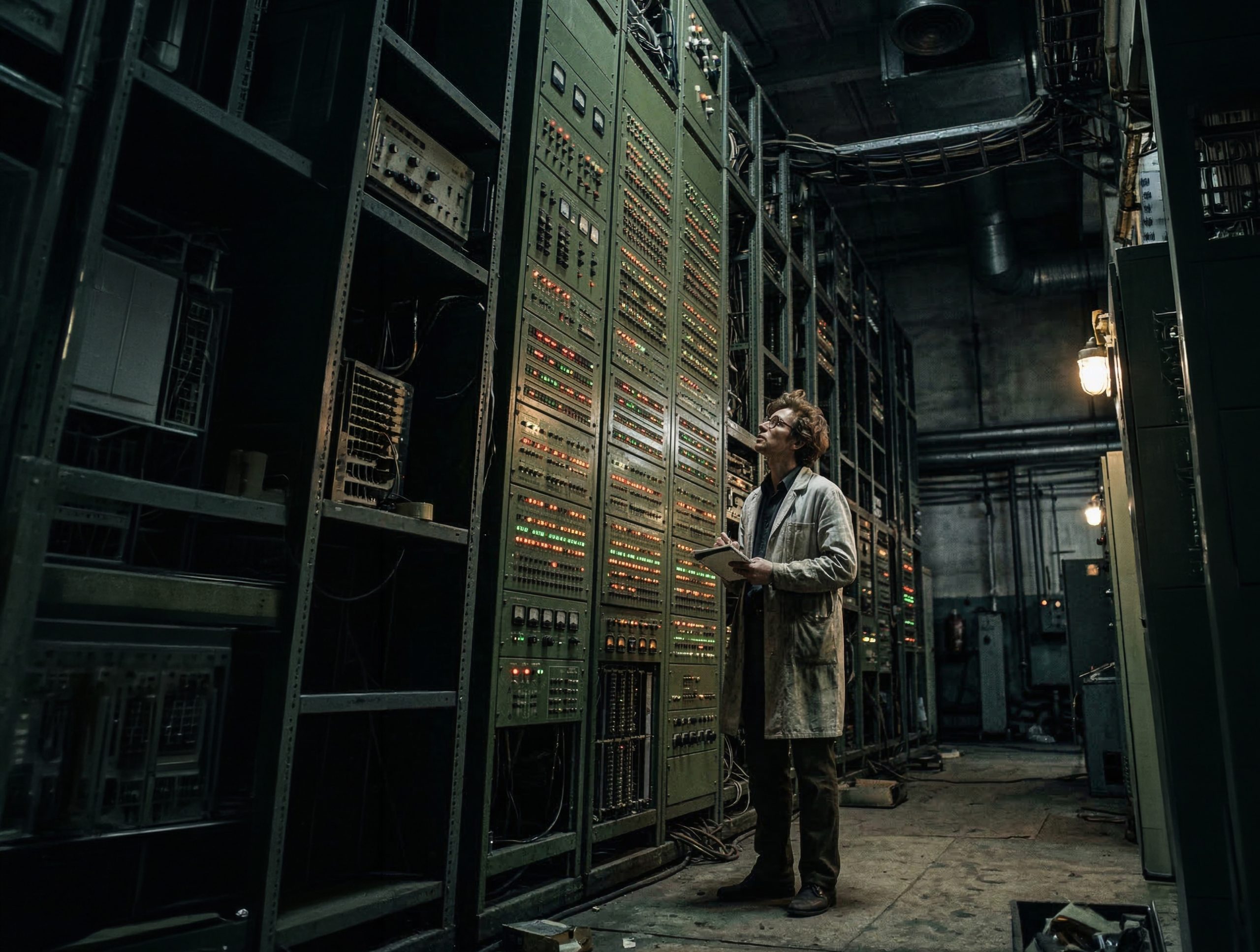
There are things you never expect to do while writing a novel.
For example, you don’t expect to spend three weeks studying the technical specifications of a Soviet supercomputer from the 1960s. You don’t expect to develop a peculiar sense of nostalgia for a machine you’ve never seen, in a country that no longer exists, during an era before you were even born.
The BESM-6—Bolshaya Elektronnaya Schetnaya Mashina, or Large Electronic Computing Machine—a name that alone is worth the price of the novel, was the crown jewel of Soviet computing throughout the 1970s.
It occupied half a room. It radiated heat like a small nuclear reactor. Its cabinets were painted military green because, in the Soviet Union, everything seemed to be military green—including, quite possibly, birthday cakes. It consumed electricity like a twelve-story apartment building. And it hummed. Constantly. A low, steady, honest hum.
In my novel NOISE:77, the protagonist, Ivan, works at an astronomical observatory in Crimea. Around him is a system built on lies: colleagues who falsify results to satisfy their superiors, superiors who falsify reports to satisfy the Party, and the Party itself falsifying reality to satisfy its own narrative. The chain of deception has existed for so long that no one remembers where it began.

But the BESM-6 knows nothing about propaganda.
It knows nothing about the political consequences of an inconvenient result. It doesn’t fear the Gulag. You feed it data. It processes the data. It returns an answer. If the input is wrong, the output will be wrong—but at least it will be wrong consistently, without hidden motives.
And that’s the thought that kept me awake.
Today we have machines that are millions of times faster and billions of times more capable than the BESM-6. We trust them unconditionally with almost every aspect of our lives: GPS navigation, medical diagnoses, social media feeds, credit scores, hiring decisions.
The problem is that, unlike the BESM-6, these modern machines are anything but neutral.
They are trained on human data, built to serve human objectives, by people with human interests. They have learned from our biases, our systematic mistakes, and the stories we prefer to tell ourselves.
In a strange way, the BESM-6 was more honest precisely because it was less intelligent.
It could only calculate what you asked it to calculate. It couldn’t “learn” to produce the answers we wanted to hear.
While writing NOISE:77, I realized that Ivan doesn’t trust the Beast because it is infallible.
He trusts it because it is transparent.
He knows exactly how it works. He knows what it can and cannot do. He knows where the limits of the machine end and the limits of human beings begin.
None of us can honestly say we understand how the AI systems we use every day truly work.
The BESM-6 was noisy, slow, hot, enormous, and inefficient.
It was also, in its own way, honest.
I already miss it.